


Without Turning Your Plant Into a Spreadsheet Nightmare
Manufacturing executives often say the same thing: “We have data everywhere… but no visibility anywhere.”
Production planners juggle spreadsheets, supervisors chase paper job travelers, and management gets yesterday’s numbers when they actually need right-now decisions.
That’s exactly where Epicor Kinetic changes the game.
Epicor Kinetic is designed specifically for manufacturers and distributors, providing modular production tools that can grow with your factory instead of forcing a risky “big bang” ERP overhaul. With the right implementation partner—like Data V Tech Solutions, an Epicor partner supporting manufacturers across Asia-Pacific—factories can digitize operations step by step while keeping production running.
Let’s break down how Epicor actually improves factory operations in the real world.
1. Modular Manufacturing Architecture: Start Small, Scale Smart
One of Epicor Kinetic’s biggest strengths is its modular design.
Instead of deploying a massive ERP system all at once (which historically leads to headaches, budget explosions, and angry production managers), manufacturers can implement core modules first and expand later.
Typical rollout sequence:
- Job Management
- Advanced Production
- MES (Manufacturing Execution System)
- Lean / Kanban
- Quality Management
This approach delivers several advantages:
- Lower implementation risk
- Faster time-to-value
- Incremental process optimization
- Licensing aligned with actual operational needs
In plain manufacturing language: fix the bottleneck first, not the entire factory at once.
2. Job Management: The Backbone of Production Control
Every manufacturing operation revolves around jobs.
Epicor’s Job Management module provides a centralized system to create, schedule, and monitor production jobs across different manufacturing strategies:
- Make-to-Order (MTO)
- Make-to-Stock (MTS)
- Configure-to-Order (CTO)
- Engineer-to-Order (ETO)
Instead of juggling spreadsheets, emails, and paper instructions, planners can:
- Create jobs automatically from sales orders
- Track materials, labor, and machine usage
- Monitor work-in-progress (WIP)
- Manage job costing in real time
The operational results are immediate:
- Shorter lead times
- Fewer planning errors
- Improved on-time delivery performance
And perhaps most importantly: production planning stops being a guessing game.
3. Advanced Production: Reducing Setup Time and Shop Floor Chaos
Many factories suffer from an invisible productivity killer: setup inefficiency.
Epicor’s Advanced Production module introduces batching, which groups similar operations into a single job.
For example:
Instead of running 20 small jobs with repeated setups, Epicor allows manufacturers to:
- Combine similar tasks
- Run larger optimized batches
- Reduce machine changeovers
Operational impact:
- Less setup downtime
- Simplified scheduling
- Cleaner WIP tracking
- Lower administrative workload
In other words, the system helps factories stop wasting time doing the same setup five times.
4. MES: Real-Time Visibility from the Shop Floor
Most ERP systems struggle with one major problem: they rely on delayed data entry.
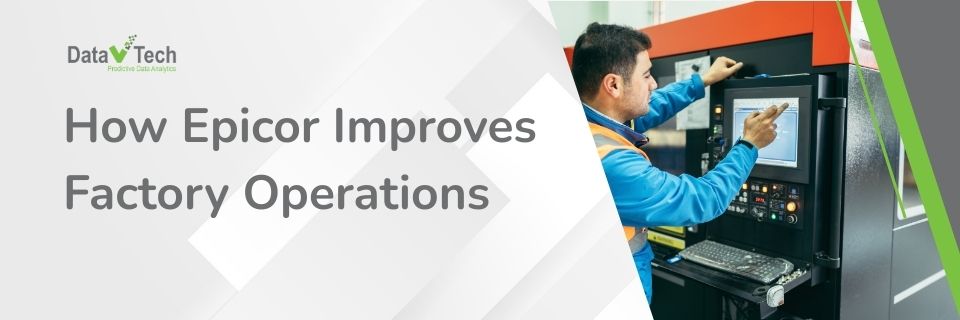
Epicor’s Manufacturing Execution System (MES) fixes this by collecting real-time shop floor data directly from operators and machines.
Using simple interfaces such as:
- Touchscreens
- Barcode scanners
- Machine integration
MES captures:
- Labor time
- Machine activity
- Scrap quantities
- Downtime events
- Work-in-progress status
This gives supervisors live visibility into production performance.
Instead of discovering problems tomorrow morning, managers can identify bottlenecks while they’re happening.
That’s the difference between:
- Reactive management
- Data-driven manufacturing.
5. Lean Manufacturing and Kanban: Less Inventory, More Flow
Inventory is often the largest hidden cost in manufacturing.
Epicor supports Lean and Kanban production models, enabling factories to maintain smoother material flow while reducing unnecessary inventory buildup.
With built-in Kanban support, manufacturers can:
- Trigger replenishment automatically
- Reduce excess work-in-progress
- Improve production flow
- Minimize waste
The financial benefits include:
- Lower inventory carrying costs
- Improved cash flow
- More stable production throughput
Lean production isn’t just a philosophy anymore—it becomes part of the system.
6. Quality Management: Turning Quality Data into Operational Insight
Quality problems don’t just affect customers—they destroy profitability.
Epicor’s Quality Assurance and Advanced Quality modules connect quality events directly to production operations.
Manufacturers can track:
- Scrap
- Rejects
- Non-conformance reports
- Inspection results
- Supplier quality performance
Most importantly, quality data is linked to:
- Jobs
- Parts
- Suppliers
- Production batches
This improves:
- Traceability
- Root cause analysis
- Costing accuracy
- Compliance reporting
Instead of guessing where defects came from, manufacturers can trace the exact production context.
7. Real-Time Operational Intelligence
Epicor also provides dashboards and analytics that transform raw production data into actionable insights.
Managers can monitor:
- Job progress
- Machine utilization
- Inventory levels
- Production efficiency
- Order fulfillment status
The result?
Manufacturers can make data-driven decisions faster—whether that means re-prioritizing jobs, adjusting schedules, or resolving supply chain disruptions.
8. Mixed-Mode Manufacturing Support
Modern factories rarely operate with just one manufacturing model.
A single company might run:
- Make-to-stock products
- Engineer-to-order projects
- Configure-to-order assemblies
Epicor Kinetic supports mixed-mode manufacturing, allowing all production strategies to operate within one integrated system.
This is particularly valuable for industries such as:
- Metal fabrication
- Automotive components
- Plastics manufacturing
- Industrial equipment
Instead of running separate systems for each process, manufacturers gain one unified operational platform.
9. Scalability for Growing Manufacturers
As factories grow, operational complexity increases quickly.
Epicor’s modular architecture allows companies to expand their system capabilities with modules such as:
- Advanced scheduling
- Multi-site production
- Supplier collaboration
- Machine connectivity
- Mobile manufacturing apps
With the right partner, manufacturers can continuously evolve their ERP platform instead of replacing it every five years.
That’s where Data V Tech Solutions comes in.
As an Epicor partner with over 20 years of ERP implementation experience, Data V Tech helps manufacturers deploy Epicor Kinetic, MES, and integrated solutions tailored to their operational needs.
Translation: less ERP drama, more production results.
Epicor Kinetic improves factory operations by connecting every layer of manufacturing:
- Production planning
- Shop floor execution
- Quality control
- Inventory management
- Operational analytics
Instead of fragmented systems and manual reporting, manufacturers gain a unified digital production environment.
The result is exactly what modern factories need:
- Higher operational efficiency
- Real-time production visibility
- Leaner inventory management
- Better decision-making
And if implemented correctly, it turns your ERP system from a reporting tool into a true operational control center.